
There is no single grams-per-shirt figure for DTF powder or ink: consumption scales with your design coverage, white-ink underbase, powder application method and film width. What you can do is measure each job in three units — film in linear meters, ink in millilitres, powder in grams — then convert those numbers into reorder quantities using the pack formats your supplier actually quotes. This guide gives you the measurement routine and the conversion math.
The three consumables that actually vary per print
Film: measure linear meters, not sheets
Film is the easiest variable to control because it is sold by roll width and length. Track how many meters of 30 cm, 33 cm or 60 cm roll each job consumes, then divide by roll length to get jobs per roll. Buyers who think only in “sheets” tend to over- or under-order when they switch between A4/A3 layouts or roll widths.
ChromaBind carries DTF transfer film in 30 cm, 33 cm and 60 cm roll widths. If you have not settled on a width for your printer, start with the film width guide.
Ink: track millilitres, and white is your biggest variable
Ink use is best tracked in millilitres per print or per square meter. In most DTF jobs the white underbase is the largest single ink cost, so a small change in underbase density changes total ink consumption more than CMYK does. Log white and colour separately, not as one “ink” number.
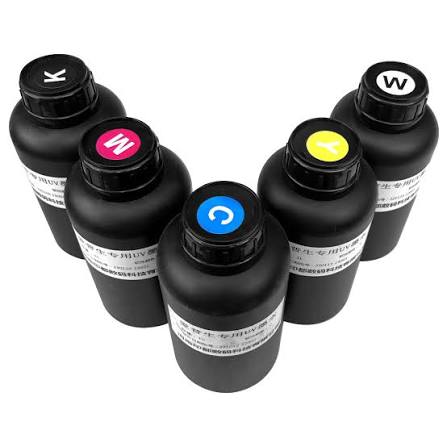
For how to evaluate whether your white ink is covering properly before you commit, see the white ink opacity guide. ChromaBind supplies DTF ink (white + CMYK) in 20 kg cartons.
Powder: weigh it, don't guess
Powder is the consumable most shops estimate wrong because the amount that actually melts onto the print depends on design coverage, the shake-off method and the grade you run. The reliable method is to weigh the powder container before and after a job, subtract recovered powder, and record grams per print.
Grade and particle size also shift how powder behaves at a given coverage. For matching 80-170u grade to fabric, see the particle size guide. ChromaBind supplies DTF hot melt adhesive powder in 1 kg packs, 5 kg packs, 20 kg cartons, drums and 25 kg bags.
A three-step measurement routine
- Film — mark the roll at the start and end of a job, record meters used, and note the width.
- Ink — record ink cartridge or bottle weight before and after (1 g is close enough to 1 ml for planning), split white from CMYK.
- Powder — weigh powder before the run, weigh what remains after shake-off and recovery, and subtract.
Run this for a week of real jobs, not one “perfect” sample, so you capture the waste and reprints that a single demonstration print hides.
Worked planning example (100 shirts)
The numbers below are a worksheet to fill with your own measured values — they are not ChromaBind specifications.
| Consumable | Example usage per print | 100 prints | Notes |
|---|---|---|---|
| Film (60 cm) | 0.12 m | 12 m | grows with layout and spacing |
| Ink — white | 4 ml | 400 ml | largest variable in most jobs |
| Ink — CMYK | 2 ml | 200 ml | depends on colour coverage |
| Powder | 8 g | 800 g | depends on coverage and grade |
Using those example values, 100 shirts need roughly 800 g of powder — just under one 1 kg pack — and 600 ml of combined ink. Your real figures will differ; the point is to have a repeatable way to predict the next order instead of guessing.
What changes consumption
- Design coverage — a full-bleed A3 graphic uses far more powder and ink than a small chest logo.
- White underbase density — a heavier underbase raises ink use and can also demand more powder for a clean bond.
- Powder grade and particle size — 80u and 170u powders behave differently at the same coverage.
- Film width and nesting — wider rolls and tighter nesting reduce film meters per print.
- Peel type and curing — hot-peel and cold-peel films and your curing settings affect how much powder stays on the film.
Turning usage into reorder quantities
Once you have grams, millilitres and meters per print, convert them to the pack formats you will actually order:
- Powder: divide your forecast grams by 1 kg, 5 kg or 20 kg to get pack counts. See the powder pack format guide for how packs, drums and 25 kg bags convert into cartons and container space.
- Ink: convert millilitres to kilograms and divide by the 20 kg carton size; order white and CMYK separately.
- Film: divide total meters by roll length per width.
Send those pack counts with your target SKUs through the RFQ form and we will quote packing, carton, gross weight and CBM references against the current SKU records — not a family-level guess.
Don't stop at consumables
Powder, ink and film are only part of your true cost per shirt. Independent guides point out that shops that only track direct consumables miss labour, waste, equipment wear and reprints — “forgetting half the equation” (DTF France, How much does a DTF print really cost per garment?). Add freight, duty and VAT on the import side and your landed cost changes again — see our landed cost guide.
For a step-by-step cost breakdown and a free calculator, see Digitech's DTF Printing Cost Per Shirt: Ink, Film & Powder Cost Breakdown and MakersMath's DTF Printing Cost Calculator.
Sources
- Digitech, “DTF Printing Cost Per Shirt: Ink, Film & Powder Cost Breakdown” — https://digitechfm.com/dtf-cost-per-shirt-ink-film-powder/
- DTF France, “How much does a DTF print really cost per garment?” — https://www.dtf-france.com/en/blog/how-much-does-a-dtf-print-really-cost-per-garment
- MakersMath, “DTF Printing Cost Calculator” — https://www.makersmath.com/dtf-printing-calculator