
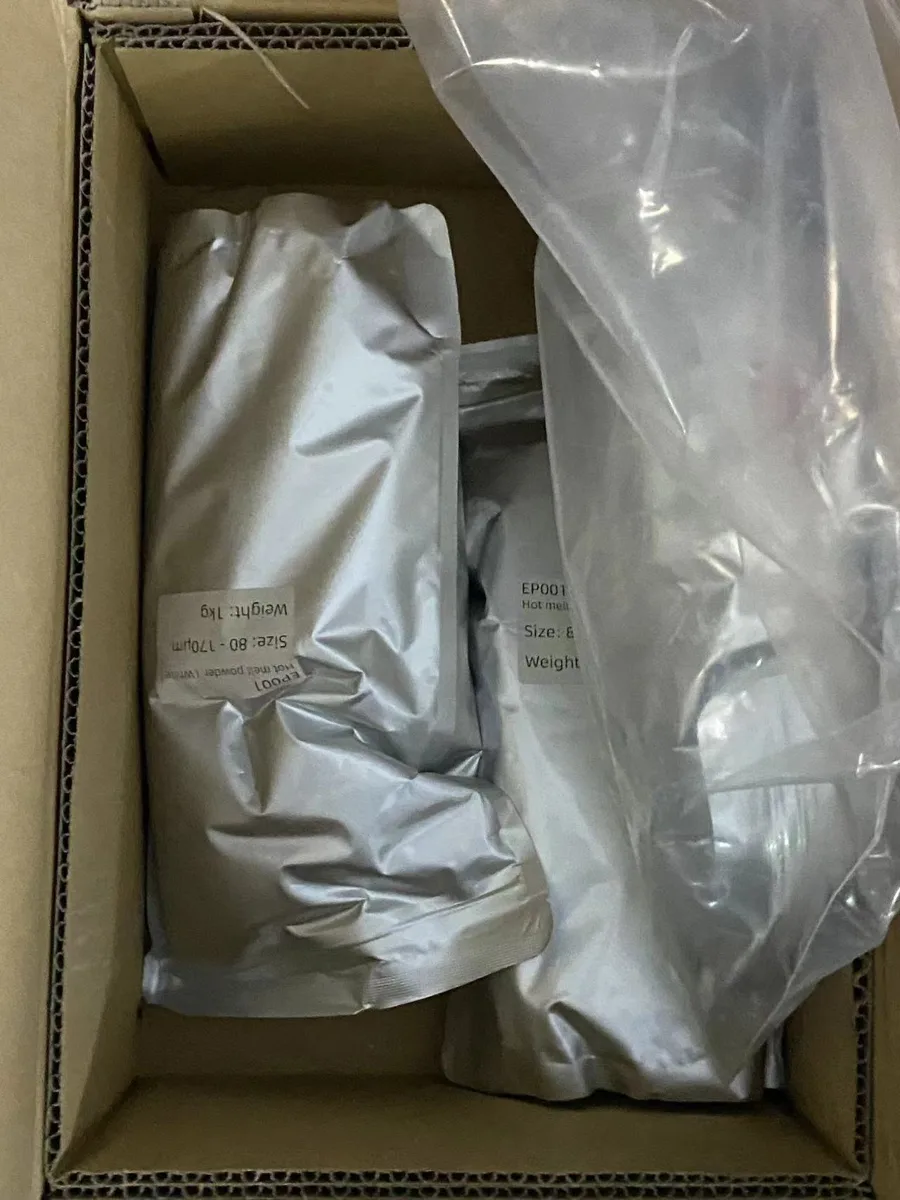
Short answer: ChromaBind's DTF hot melt adhesive powder ships in six pack formats, from 1kg reseller packs (20 per carton) up to 25kg bags and 20–25kg drums. Each format has a recorded carton size, gross weight and CBM — the numbers you need to work out landed cost, pallet count and 20GP container loading. This guide walks through the formats and the container math so you can request the right pack for your channel.
The six powder pack formats at a glance
DTF hot melt powder is a TPU adhesive powder available in three grades — ep005 80–170u, ep001 80–170u and 1-NO — packed to serve different buyers:
| Pack format | Net weight | Gross weight | Carton dimensions (m) | CBM per unit |
|---|---|---|---|---|
| 1kg packs ×20 (20kg carton) | 20 kg | 21 kg | 0.27×0.53×0.25 | 0.0358 |
| 5kg packs ×4 (20kg carton) | 20 kg | 21 kg | 0.27×0.53×0.25 | 0.0358 |
| 20kg carton — ep005 | 20 kg | 22 kg | 0.52×0.35×0.25 | 0.0501 |
| 20kg carton — ep001 | 20 kg | 22 kg | 0.52×0.32×0.23 | 0.0383 |
| 20kg carton — 1-NO | 20 kg | 22 kg | 0.645×0.21×0.21 | 0.0383 |
| 20kg drum | 20 kg | 22.5 kg | 0.34×0.34×0.47 | 0.0543 |
| 25kg drum | confirm at quote | 23.5 kg | 0.34×0.34×0.47 | 0.0543 |
| 25kg bag | 25 kg | 26.2 kg | 0.76×0.42×0.12 | 0.0338 |
Two notes on the table. First, the 20kg carton carries three different grades and each has slightly different carton dimensions, so the CBM per carton differs (0.0383 to 0.0501 m³) — that difference matters once you multiply it across a container. Second, the factory sheet lists net weight as 20kg for the 25kg drum row, so we confirm that figure in the quotation rather than assume it.
These figures come from the current DTF hot melt adhesive powder catalog record. They are packing references, not commercial MOQs — a carton count is not a minimum order.
What each format is for
- 1kg packs ×20 — the reseller and ecommerce format. Easy to list, store and ship in small units, with minimal repacking.
- 5kg packs ×4 — the studio and light-production format; fewer handling steps than 1kg bags but still controllable in a small shop.
- 20kg carton (ep005 / ep001 / 1-NO) — the distributor workhorse. You order by grade and repack into your own branded units or run it directly.
- 20kg / 25kg drums — sealed bulk for larger production lines and repackers.
- 25kg bag — the lowest-handling-cost bulk format for high-volume printers and importers.
If you are matching grade to fabric, see our guide on DTF powder particle size and grade; if you are planning storage, see DTF hot melt powder storage and shelf life.
Pallet and 20GP container math
Packing references scale up in a recorded way:
| Load unit | Detail |
|---|---|
| Pallet | 36 cartons, 720kg net / 735kg gross, 1.1×1.1×1.65m, 1.9965 m³ |
| 20GP container | 639 cartons × 20kg, 12,780kg net / 13,419kg gross, 22.5 m³ |
A standard 20-foot general-purpose container has roughly 33.2 m³ of internal volume and a payload limit around 25,700 kg (CalculateCBM container reference). The 639-carton powder load above occupies about 22.5 m³ and about 13.4 tonnes gross — comfortably inside a 20GP, which is exactly why powder is usually combined with film and ink in one mixed container rather than shipped as a powder-only load. For how that mix works, see mixed DTF container loading.
The quick working rule: take the CBM of your chosen format, multiply by the number of units you plan to import, then compare that total against the container's usable volume — and the gross weight against the payload limit. The pack-format table above gives you the per-unit CBM to start from.
Choosing a pack format for your channel
Ecommerce and marketplace resellers
Start with 1kg packs. They keep the resale unit small, simplify carton marks and barcode handling, and reduce the working capital tied up in one order. You still buy a full 20kg carton (20 packs), but you sell it down in 1kg units.
Studios and small production shops
5kg packs are the usual balance: fewer handling steps than 1kg, and a single carton (4 packs, 20kg) is manageable on a small shelf. Choose grade by fabric — ep005 and ep001 are both 80–170u.
Distributors and high-volume importers
Run 20kg cartons by grade, 25kg bags, or 20/25kg drums. When you mix powder with film and ink in one 20GP, work the CBM numbers before locking a load plan — powder at the recorded 639-carton reference uses about 22.5 m³ and 13.4 tonnes gross, leaving headroom for the other consumables. See the landed cost guide to turn those numbers into a per-kg import cost.
What to confirm before you order
- Grade and particle size. ep005 80–170u, ep001 80–170u and 1-NO are listed in the catalog; confirm which one matches your printer and fabric before committing.
- HS code. 3909500000 is recorded for the powder as a quote reference. Final customs classification is the importer's or customs broker's responsibility for the destination country.
- MOQ and price. These are confirmed per SKU, quantity, packing and destination in the quotation — a carton count in this article is not a MOQ.
- SDS/MSDS and transport documents. Documentation status is verified for the selected SKU and shipment; available document identifiers and scope are shared with the quotation. Liquids and powders have different shipping rules, so this is checked case by case rather than assumed.
- Lead time. Depends on product, quantity, packing and production schedule; confirm in the quotation.
Send the SKU, quantity, pack format and destination port through the RFQ form and we'll return a SKU-level quotation with the packing references above.