
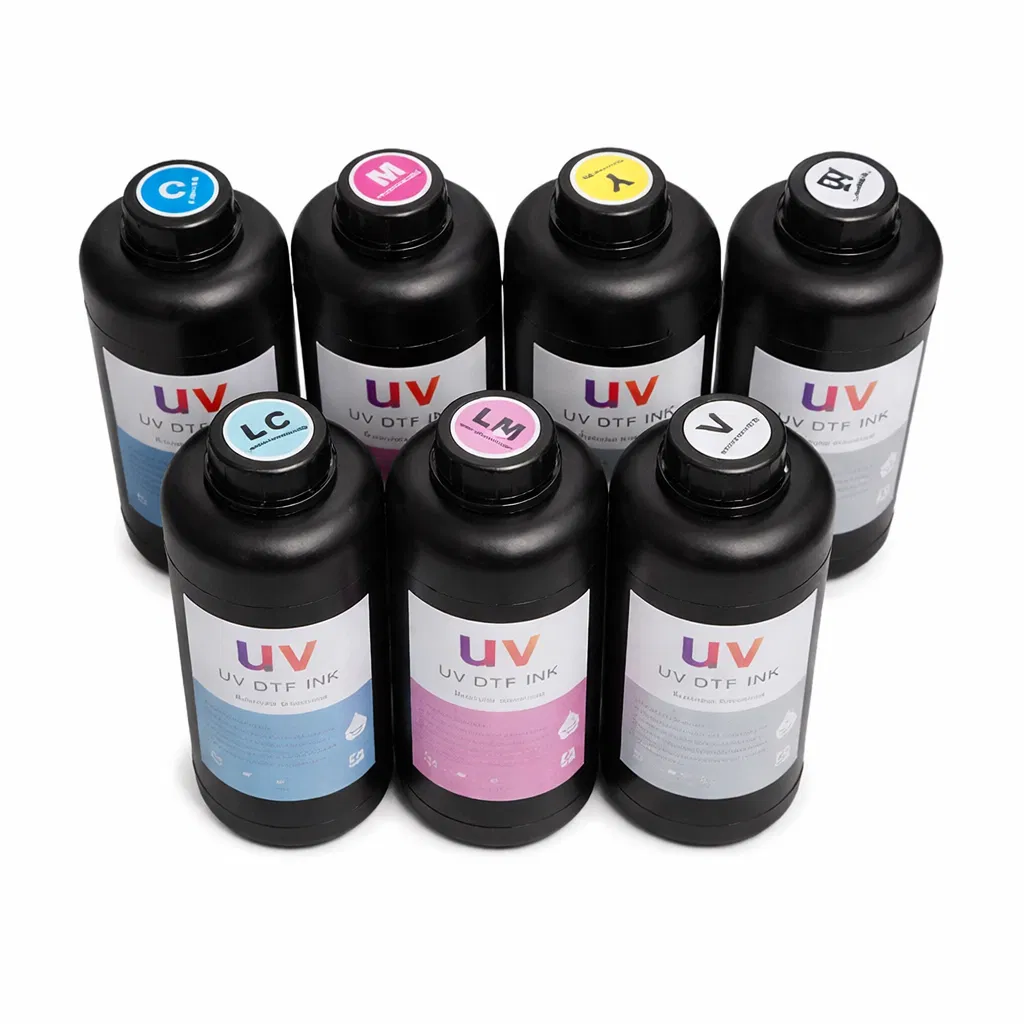
UV flatbed ink is a UV-curable ink set — cyan, magenta, yellow, black, white and varnish — printed straight onto rigid or semi-rigid substrates and cured by the machine's UV lamp as the print passes. There is no transfer film and no heat press in the process. ChromaBind supplies it as one complete set: 20 kg per carton, 20 bottles per carton (SKU CB-UVFB-SET-20C; carton 0.47 x 0.36 x 0.24 m, 22 kg gross, 0.038272 CBM).
The headline price per litre is the least useful number on a flatbed ink quote. What decides whether an order runs cleanly is whether the ink matches your printhead and lamp, whether the colour split matches what your machine actually consumes, and whether the packing and documentation survive your import route.
View UV flatbed ink specifications
UV flatbed ink is not UV DTF ink — and neither is DTF ink
These three families sit in the same catalogue and are frequently confused, partly because they share an HS reference. They are not interchangeable: different chemistry, different printheads, different finishing.
| UV flatbed ink | UV DTF ink | DTF ink | |
|---|---|---|---|
| Printed onto | Rigid / semi-rigid substrate directly | A film, then laminated to B film | PET transfer film |
| Colour set | CMYK / white / varnish | CMYK / white / varnish | White + CMYK |
| Cure method | UV lamp on the printer | UV lamp on the printer | Powder + heat press |
| Typical output | Signage, panels, promotional items, hard goods | Crystal labels for cups, glass, hard goods | Apparel transfers |
| HS reference | 3215902000 | 3215902000 | 3215902000 |
A shared HS reference means the customs chapter is similar, not that the products are. Routing a flatbed ink enquiry to a DTF ink supplier — or the reverse — is one of the most common sourcing errors on this family. If you run both processes, specify them as separate line items so the quotation keeps the chemistry apart.
For the crystal-label side of the catalogue, see the UV DTF ink buyer's guide. For apparel transfers, start from DTF ink.
The packing numbers to put in your RFQ
Flatbed ink is dense and heavy relative to its volume, which changes the freight maths compared with film or powder.
| SKU | Set | Carton quantity | Carton size (m) | Gross weight | CBM | HS reference |
|---|---|---|---|---|---|---|
| CB-UVFB-SET-20C | CMYK / white / varnish | 20 KG/ctn, 20 bottles | 0.47 x 0.36 x 0.24 | 22 kg | 0.038272 | 3215902000 |
Three things to do with that row:
- Give your forwarder the CBM and the gross weight together. Sea freight is charged by volume; air freight and some LCL routes price on the higher of gross weight and volumetric weight. A heavy, compact ink carton behaves differently on each.
- Compare CBM before comparing unit price. A lower per-litre price in a bulkier carton can cost more landed than a higher-priced, tighter pack.
- Treat the HS reference as a starting point. 3215902000 is the reference carried on the current SKU record. Final classification belongs to your importer or customs broker and varies by destination and exact composition.
Carton quantity is not MOQ. "20 bottles per carton" describes the box, not the minimum order. Ask for the commercial MOQ separately and in writing, per SKU.
For how these fields behave across film, powder and ink together, see how to read a DTF consumables quote and mixed container loading.
Eight things to confirm before you commit
- Printhead compatibility. Ask for a written compatibility statement naming your printhead family. "Works with UV printers" is not a statement.
- Lamp and cure match. Ink formulated for one lamp type may not cure fully under another. Confirm the ink is specified for your machine's curing setup.
- Colour split. A CMYK / white / varnish set is not consumed at equal rates, and white and varnish usually draw down at a different pace from CMYK. Ask how the set is split by bottle and whether it can be rebalanced.
- Shelf life and storage. Get the shelf life and storage temperature range in writing, and ask whether the bottles ship with protection against temperature swings in transit.
- Packaging integrity. Ink is a liquid in bottles. Ask whether the carton includes inner partitions, and whether a leakage test record exists.
- Transport documentation. Ask what SDS/MSDS and transport appraisal documentation is available for the specific product and destination before booking freight. This is a per-product, per-destination question — a generic answer is not an answer. Do not assume air freight is available for any liquid ink.
- MOQ status. Either an exact quantity, or an explicit "to be confirmed for this SKU". Both are usable; silence is not.
- Lead time status. Confirm against your real production window rather than a catalogue figure.
If a supplier cannot answer 1, 6 and 7 in writing, that is the signal to slow down. Our own bulk-order evaluation checklist treats these as gating items.
Handling: the part your supplier and your print room share
UV-curable ink is not finished until it is cured, and the exposure risk sits with the uncured ink — on the print, on gloves, on rags — rather than with a dried film. That is why wide-format UV ink printing is treated as a controlled process with defined engineering controls, not a "safe once it cures" one.
The UK Health and Safety Executive publishes a COSHH essentials sheet specifically for this process, covering the controls expected in wide-format printing with UV-curable inks:
- HSE, COSHH essentials in the printing industry: Digital (inkjet) printing — Wide-format printing with UV-curable inks (P40): https://www.hse.gov.uk/pubns/guidance/p40.pdf
Two practical consequences for buyers. First, the machine should have extraction or ventilation appropriate to the process, and operators should be working with gloves and eye protection suited to uncured ink handling. Second, if you are the importer, your SDS file for the ink you buy should follow the shipment — and you should be the party holding it rather than relying on the supplier at the far end. See import documentation basics for what to collect before you ship.
For printhead maintenance between runs, the cleaning solution guide covers what to confirm on that consumable.
Reordering: plan ink against the container, not the calendar
Ink is the consumable that most often runs a shop dry mid-job, because reorder points get set on perceived usage rather than recorded drawdown. Two habits fix most of it:
- Log drawdown by colour. In a flatbed workflow, white and varnish typically run short first while CMYK runs longest. A per-colour log turns your next order into arithmetic instead of a guess.
- Plan the reorder against your load. Ink cartons are dense: a compact carton with a 22 kg gross weight fills weight faster than it fills volume. Adding two or three ink cartons to a film and powder load often uses container space efficiently, which is why mixed loads move ink cheaply. See mixed container loading for the CBM maths.
Common questions
Can I use one "UV ink" to cover both flatbed and UV DTF work?
Not reliably, and not without a written compatibility statement covering both machines. The two products share a colour naming convention and an HS reference but are formulated for different printheads and different film or substrate behaviour. Buying one and using it for both is a risk you take on your own equipment.
How often should I reorder?
There is no universal interval. It depends on your print coverage, your colour mix and your container schedule. Record actual drawdown for one production cycle, then set the reorder point from that data and align it with your next consolidated shipment.
Does a lower price per litre always win?
No. Landed cost is price plus freight plus duty, and freight depends on CBM and gross weight. A cheaper ink in a larger, heavier carton can land higher than a tighter pack. Compare the full packing row, not the unit price.
Next step
Send an RFQ with four things: your target colour set, your printhead or machine model, your estimated monthly volume, and your destination port. You will get back per-SKU packing data, sample route status, MOQ status and lead time status for the exact SKU rather than a family-level estimate.
Request a quote or contact us with your machine details and we will confirm what applies to your setup.