
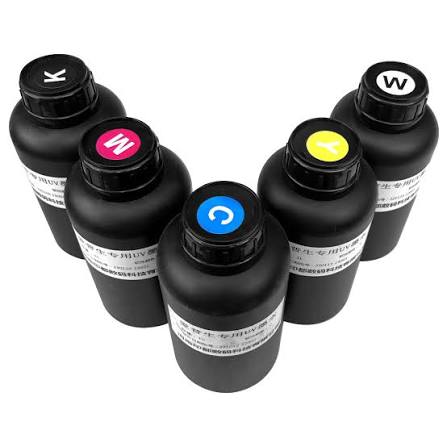
White ink is the pacing item in every DTF production line. You can stretch film inventory, negotiate powder deliveries, and work around a missing CMYK cartridge — but when white ink runs out, printing stops. A reorder program built around white ink consumption, supported by batch records and compatibility checks, is the difference between uninterrupted production and a line-down phone call to your supplier.
This guide covers how to structure a DTF ink reorder program, what batch data to request from your supplier, and how to manage compatibility when new ink arrives.
Why White Ink Drives Your Reorder Timing
White ink is the most technically demanding consumable in a DTF workflow. Unlike CMYK inks — relatively stable pigment dispersions — white ink carries a high loading of titanium dioxide (TiO₂), typically 10–20% by weight, to produce the opacity needed for transfer printing onto dark fabrics. These TiO₂ particles are denser than the carrier fluid, so sedimentation begins the moment the ink stops moving (Superinks, 2025).
This single physical reality shapes every buying decision: how much to order, how often, and what to check when a new batch arrives.
For production shops, white ink consumption runs 2–4 times the rate of any single CMYK color. Most shops burn through white at 4–8 liters per week for a single-shift operation; high-volume shops can exceed 20 liters weekly. When white ink is the majority of your ink spend and the bottleneck if it runs out, your reorder program should be built around it.
What a Batch Record Should Include
A batch record is not just a date code printed on the bottle. For a buyer managing consistent output, it is the reference data that lets you assess whether a new delivery will behave like the last one. At minimum, ask your supplier for:
- Batch/lot number — the identifier that ties this production run to the manufacturer's internal QC records.
- Production date — to calculate remaining shelf life and verify storage conditions before the ink reached you.
- Viscosity specification — measured in centipoise (cP) at a stated temperature. Variations beyond ±10% from your reference batch can affect jetting performance and drop placement.
- Particle size distribution — D50 and D90 values for the TiO₂ dispersion. This directly affects opacity, sedimentation rate, and the lifespan of your printer's filters.
- Filtration pass record — whether the batch passed the manufacturer's specified filter mesh before filling. Standard practice for DTF white ink is a 1-micron absolute filter.
If your supplier cannot provide these data points, you are buying blind. A reorder program without batch traceability is just a calendar reminder — not a quality program.
Structuring a Reorder Program That Prevents Downtime
A practical reorder program runs on consumption data, not guesswork. Here is a four-step framework for production shops and distributors:
Step 1: Measure your white ink burn rate
Track white ink usage separately from CMYK. Record liters consumed per week over at least four weeks to establish a reliable average. Ignore outlier weeks (machine downtime, unusually large or small orders) when calculating your baseline.
Step 2: Calculate your safety stock
A reasonable buffer is 2–3 weeks of consumption on the shelf, plus your supplier's confirmed lead time in weeks.
For example: if your supplier quotes a 3-week lead time and you burn 8 liters per week, you need at least (3 + 2) × 8 = 40 liters of white ink in stock when you place the next order.
Step 3: Factor in CMYK consumption
CMYK consumption is more uniform across colors when printing full-color designs. A typical ratio for general DTF work:
| Ink Color | Approximate Share of Total Ink Volume |
|---|---|
| White | 40–55% |
| Cyan | 10–15% |
| Magenta | 10–15% |
| Yellow | 10–15% |
| Black | 10–15% |
Order CMYK colors together to maintain a single batch reference across your color set. But avoid over-ordering CMYK relative to white — CMYK inks have similar shelf-life considerations and sitting inventory is wasted working capital.
Step 4: Set a reorder trigger, not a calendar date
When white ink stock hits the safety threshold, place the order. A calendar-based schedule works only if your production volume is perfectly predictable — and in custom garment printing, it rarely is.
Compatibility: Matching New Batches to Your Existing Setup
The question every production manager asks: "Will this new batch work in my printer with my existing film and powder?"
Compatibility is not a yes/no property of the ink. It is the relationship between three things:
Your printhead type. Epson i3200, i1600, XP600, 4720, and Ricoh Gen5/Gen6 printheads have different jetting characteristics. An ink formulated for one printhead family may not jet reliably in another. Your first question when evaluating a new ink supplier is whether the ink was specifically formulated for your printhead.
Your film-powder combination. DTF ink must wet the film coating correctly, release cleanly during transfer, and bond with your hot-melt powder grade. A batch that passes lab tests on the supplier's reference materials may behave differently on yours. This is why a sample-validation route is recommended before committing to a reorder program: test the incoming batch with your actual printer, film, and powder under your real production conditions.
Batch-to-batch variation. Even from the same supplier, ink batches can vary within tolerance. The right question is not "is this batch identical to the last one?" but "does this batch fall within the specification range I have validated on my line?" A supplier that provides batch-level data lets you answer this before you open the first carton.
If you are switching suppliers, do not transition mid-production. Run the old batch to completion, flush the ink system thoroughly, then introduce the new batch with a test cycle. This isolates any compatibility issue to a single variable.
Storage and Handling Between Deliveries
Ink quality degrades on a predictable curve driven by three factors: temperature, time, and agitation.
Temperature. DTF pigment inks should be stored between 15°C and 30°C (59–86°F). Temperatures above 35°C accelerate sedimentation and can trigger premature curing of binder components. Below 5°C, component separation and irreversible viscosity changes become a risk. If your warehouse is not climate-controlled in summer, white ink inventory should be the first consumable you protect.
Agitation. White ink bottles and cartons should be gently agitated before use — not shaken violently, which introduces air and foaming — but rolled or rocked to resuspend settled pigment. For daily use, a slow roller or the printer's automatic ink circulation system handles this. For bulk 20KG cartons in storage, manual agitation before decanting is essential.
Shelf life. Most DTF pigment inks carry a stated shelf life of 12 months from production date under correct storage. White ink is the most sensitive component. Once a carton is opened and exposed to air, the practical working window shortens. Use opened white ink within 30–60 days wherever possible.
First-in, first-out (FIFO). Label every carton with its batch number and arrival date. Rotate stock so older batches are consumed first. This is basic inventory discipline — and the single most common failure point in shops that scale up without formal stock control.
What to Ask Your Ink Supplier Before Setting Up a Reorder
Before committing to regular deliveries from any supplier, get clear answers to these six questions:
Batch identification. Do you assign a unique batch number to every production run, and can you provide batch-specific viscosity and particle-size data on request?
Formulation stability. Is your white ink formulation stable across production runs, or do you periodically reformulate? If you reformulate, how do you notify buyers and what transition support do you provide?
Printhead compatibility. Which printhead families has this ink been tested with, and under what conditions?
Documentation per delivery. What documentation accompanies each shipment? At minimum, expect a packing list with batch numbers, carton quantities, gross weight, and CBM for customs clearance. For inks and cleaning solutions, MSDS and transport appraisal documentation should be available — their exact scope should be confirmed for the specific product batch and destination before shipping. If you are new to importing ink consumables, see our guide on DTF import documentation for a full checklist.
Packaging consistency. Are carton dimensions, weight, and fill quantity consistent across production runs? Variation in carton-level specifications affects your CBM calculations and container planning. For reference, our DTF ink cartons are standardized at 20KG per carton — see our DTF ink product page for current carton dimensions and weight per color. If you are planning a mixed container shipment, our mixed container loading guide walks through CBM planning across film, powder, and ink.
Sample policy. Can you send a pre-shipment sample from the exact batch that will be dispatched, so we can test on our equipment before the full order arrives?
A supplier who can answer all six questions with data — not assurances — is one you can build a reorder program around.
Next steps. If you are comparing ink suppliers or reviewing your current reorder setup, start by measuring your actual white ink consumption over four weeks. That single number will tell you more about what you need than any catalog or price list. When you are ready to discuss specific ink SKUs, batch data, and a sample-validation route for your production line, request a quote and we will confirm the details for your printer, film, and powder setup.