
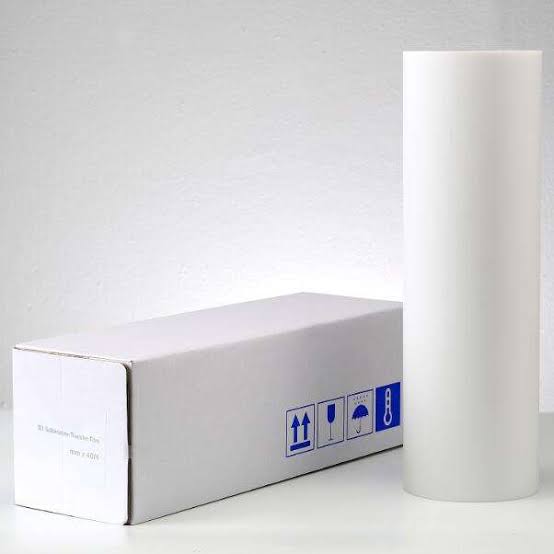
What sublimation film does — and the one-line difference from DTF film
Sublimation film (also sold as sublimation transfer paper) is the coated carrier that moves a dye-sublimation print from your printer to a finished product. The mechanics differ from DTF in a way that decides which products you can make: under heat-press temperature, sublimation dye turns to a gas and bonds into the surface of a polyester or polymer-coated substrate. It dyes the material instead of sitting on top of it.[^1]
DTF film, by contrast, carries a printed film layer that is applied with a hot-melt powder and sits on the surface. That is why DTF handles cotton and dark garments, while sublimation is limited to light-colored polyester and polymer-coated blanks — a common working threshold is around 65% polyester or higher.[^2]
The practical question for a buyer is not "which process is better" but "which one matches what your customers actually produce." Sublimation film belongs in a shop running polyester apparel, mugs, phone cases, mouse pads or metal photo panels; DTF transfer film belongs in a shop printing cotton, blends and dark garments. For a fuller comparison of the three transfer families, see our DTF vs UV DTF vs sublimation guide.
The two films are not interchangeable: a sublimation print needs sublimation ink, a sublimation printer and the right press settings, while a DTF print needs DTF ink, hot-melt powder and DTF film.
GSM is the spec that matters most
GSM (grams per square metre) is the paper weight of the transfer film. It controls how much ink the sheet can hold, how quickly it releases moisture during pressing, and how reliably it feeds through the printer.
The ChromaBind sublimation film SKU is a 70 gsm roll — a lightweight transfer weight suited to fast, high-volume roll-fed printing. Heavier weights (for example 100–120 gsm) tend to be used for slower, small-format sheet work; roll-fed sublimation lines are built around lighter weights.
When you compare suppliers, ask for the exact GSM and the roll length, because two "sublimation film" quotes can look similar until you convert them to cost per square metre.
Roll width and length decide your real cost per print
This SKU is a wide-format roll: 300 m long × 163 cm wide. A 163 cm width is sized for large-format sublimation printers — the machines used for full-width fabric panels, banners and high-volume cut-and-sew production.
Before ordering, verify two things:
- That your printer's maximum media width can take a 163 cm roll. Many desktop and mid-size sublimation printers top out far below that, and an over-wide roll you have to slit is wasted handling cost.
- That your finished-product mix actually needs the full width. If most of your work is A4/A3 sheets or narrow apparel panels, a wide roll can still be economical, but confirm your slitting and storage setup can handle a 1.6 m-wide master roll.
Width and length are the two numbers that set your real cost per print — read them against your own production, not against a competitor's spec sheet.
Reading the packing data: carton, gross weight and CBM
For import planning, the current record for this SKU gives a complete packing reference:
| Field | Value |
|---|---|
| Roll | 70 gsm × 300 m × 163 cm |
| Packing | 1 roll per carton |
| Carton dimensions | 0.19 × 0.19 × 1.65 m |
| Gross weight | 32 kg |
| CBM | 0.0596 m³ |
These are packing references, not commercial MOQ. Carton quantity describes how the roll is packed; minimum order quantity, price and lead time are confirmed separately in the quotation for your SKU, quantity, packing and destination.
Because the carton is 1.65 m long, check your freight quote against the actual carton length. Long cartons can change LCL/FCL cost assumptions and sometimes attract oversize handling charges that a shorter box would not.
What to confirm before you order
Sublimation film is a solid roll rather than a liquid or powder, so it does not carry the same transport-appraisal paperwork as inks and cleaning liquids. The specifics are still confirmed per shipment, and these items should be settled case by case:
- Printer and ink compatibility. Confirm the film coating is matched to your sublimation ink set and printer feed system.
- Final HS classification. The current packing record does not carry a universal HS code for this SKU; the final classification depends on the destination and is the importer's or broker's responsibility.
- Sample route. If you are validating a new supplier, the sample quantity, fee, freight and timing are confirmed case by case for your destination.
- MOQ, price and lead time. These are not standard values — they are set in the formal quotation once the SKU, quantity, packing and destination are clear.
None of this is a reason to wait; it is the difference between a quote you can clear through customs and one that surprises you later.
Sublimation film vs DTF film: a quick reference
| Question | Sublimation film | DTF film |
|---|---|---|
| How the image bonds | Dye turns to gas and dyes the polyester or polymer-coated surface | Printed film layer transfers on top with hot-melt powder |
| Best substrates | Light polyester fabrics and polymer-coated hard goods (mugs, phone cases, metal panels) | Cotton, blends, dark and light garments, most fabrics |
| Hand feel | No added layer — the print sits in the material | Slight film hand on the surface |
| Required ink | Sublimation ink | DTF ink + hot-melt powder |
| What to specify | GSM, roll width × length, coating, carton/GW/CBM | Width, single/double side, hot/cold peel, carton/GW/CBM |
If your customer base is mixed-fabric apparel and dark colors, DTF is usually the more flexible line. If you run a polyester or hard-goods sublimation workflow at volume, sublimation film is the consumable that keeps that line moving. Many distributors stock both, because the two processes serve different parts of the same custom-merchandise market.
If you are comparing suppliers for sublimation film, request a quote with your target width, roll length and destination, and we will confirm the SKU-level packing, sample route and documentation status for your shipment.
[^1]: Condé Systems, "Understanding DTF and Sublimation Printing: Key Differences and Applications." https://www.conde.com/Understanding-DTF-and-Sublimation-Printing-Key-Differences-and-Applications.asp
[^2]: DTF Station, "Sublimation vs. DTF Printing: Which Is Right for Your Business in 2026?" (July 2026). https://dtfstationglobal.com/sublimation-vs-dtf-printing-which-is-right-for-your-business/