
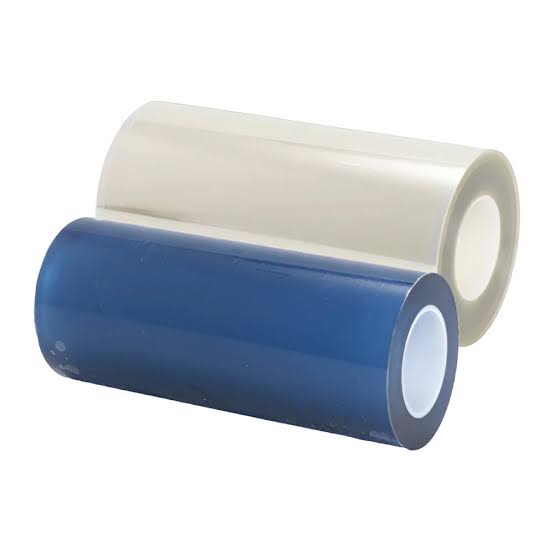
If you stock UV DTF AB film for crystal-label production, the A film base type — white thick (paper based) or double clear (clear based) — determines which substrates your customers can serve, how heavy each carton is, and what the finished label looks like. This article compares the two base types across six practical dimensions: carton packing, visual result, substrate match, production workflow, shipping cost, and stocking strategy.
This guide builds on the UV DTF AB film buyer's guide, which covers the full A-film/B-film system. Here we zoom in on the single most frequent question from distributors: which A film base should I stock, and in what ratio?
View UV DTF AB film product specs
What "white thick base" and "double clear base" actually mean
These are the factory-level names used in ChromaBind's product workbook. In the industry you may also see them called:
| ChromaBind name | Industry synonyms | Physical description |
|---|---|---|
| White thick base (paper based) | White backing paper, white background film, opaque A film, PAPER BASED | Heavier, stiffer A film with a white opaque carrier layer |
| Double clear base (clear based) | Transparent backing film, clear A film, CLEAR BASED | Thinner, lighter A film with a transparent carrier layer |
Both are print-receptive films that receive UV ink from a UV DTF printer. The difference is the carrier layer underneath the print surface: white thick base has an opaque white backing that blocks what is behind the label; double clear base is transparent, so whatever is behind the label shows through.
Carton-by-carton comparison: weight, size, quantity
The physical difference between the two base types shows up clearly in carton packing data. Here are all white thick base and double clear base A film variants side by side:
A3 sheet format
| Variant | Base | Pcs/ctn | Carton (cm) | CBM | GW |
|---|---|---|---|---|---|
| CB-AB-A3-WT-200 | White thick | 200 | 45.5×33.5×5 | 0.00762 m³ | 7 kg |
| CB-AB-A3-WT-500 | White thick | 500 | 45.5×33.5×14 | 0.02134 m³ | 16.8 kg |
| CB-AB-A3-CL-500 | Double clear | 500 | 45.5×33.5×5 | 0.00762 m³ | 11 kg |
| CB-AB-A3-CL-1000 | Double clear | 1,000 | 45.5×33.5×14 | 0.02134 m³ | 22 kg |
Notice that 500 sheets of white thick base occupy the same carton volume as 1,000 sheets of double clear base (both at 0.02134 m³). The white thick base is roughly twice as thick per sheet. For the same piece count, white thick base costs more to ship because it takes up more container space and weighs more per sheet.
Roll format (100m)
| Variant | Base | Rolls/ctn | Carton (cm) | CBM | GW |
|---|---|---|---|---|---|
| CB-AB-A-PB-310 | Paper base (31cm) | 2 | 64.5×21×21 | 0.02844 m³ | 16.6 kg |
| CB-AB-A-CL-310 | Clear base (31cm) | 2 | 65.5×17.5×17.5 | 0.02005 m³ | 11.2 kg |
| CB-AB-A-PB-610 | Paper base (61cm) | 1 | 64.5×21×21 | 0.02844 m³ | 16.2 kg |
| CB-AB-A-CL-610 | Clear base (61cm) | 1 | 65.5×17.5×17.5 | 0.02005 m³ | 11.2 kg |
The pattern is consistent: clear base cartons are approximately 30% smaller by CBM and 30% lighter by gross weight than their paper base equivalents at the same roll width. For a distributor importing by the pallet or container, this difference compounds.
Visual result: what the end customer sees
White thick base labels
The white backing is part of the finished label. After transfer, the label has a solid white under-layer that makes CMYK colours pop — the white background provides the same function as a white underbase in screen printing.
Best results on:
- Dark-coloured drinkware (black tumblers, navy mugs, matte black bottles)
- Coloured phone cases
- Opaque cosmetic packaging
- Any substrate where the label needs to stand out from the background colour
Weakness: The white edge is visible on clear surfaces. On a clear glass cup, the label has an obvious white outline that some end customers dislike.
Double clear base labels
The label transfers with no white background — only the printed ink remains on the product. The substrate colour and texture show through the transparent areas of the design.
Best results on:
- Clear glass and acrylic (drinkware, awards, display items)
- White or light-coloured substrates (white ceramic, light wood)
- Applications where a "no-label look" is desired — the ink appears to float on the surface
Weakness: On dark surfaces, CMYK colours without a white underbase look washed out or nearly invisible. A clear-base label on a black tumbler will barely show.
Substrate decision matrix
| Substrate | Use white thick base | Use double clear base | Notes |
|---|---|---|---|
| Clear glass | ❌ White edge visible | ✅ Invisible label look | Most popular use case for clear base |
| Frosted glass | ✅ White edge less noticeable | ✅ Works if edge blending matters | Both can work; end-customer preference decides |
| Black / dark tumblers | ✅ Required for colour visibility | ❌ Colours wash out | White underbase is essential on dark surfaces |
| White ceramic | ⚠️ Works but white-on-white edge shows | ✅ Clean, no visible edge | Clear base preferred for white substrates |
| Acrylic awards | Depends on acrylic colour | ✅ For clear acrylic | Match base type to substrate tone |
| Phone cases (coloured) | ✅ Opaque background needed | ❌ Ink alone too thin | Most phone cases use white base |
| Metal / aluminium | ✅ Covers metallic surface | ⚠️ Metallic sheen shows through | White base blocks substrate colour |
| Wood (light) | ⚠️ White edge contrasts with grain | ✅ Natural look preserved | Clear base blends with wood texture |
| Cosmetic bottles (opaque) | ✅ Solid coverage | ⚠️ Substrate colour may bleed through | Bottle colour determines choice |
Production workflow differences
White thick base
- Heavier feel during handling — sheets and rolls are stiffer, easier to feed manually on some printers.
- Less prone to static — the thicker material resists curling and static cling in dry environments.
- More forgiving of over-inking — the white carrier absorbs slight over-saturation without warping.
- Slower drying between colour passes if the printer's UV lamp is underpowered.
Double clear base
- Lighter and more flexible — can be trickier to feed on some sheet-fed printers; may need a carrier tray.
- More static-prone in dry conditions — anti-static measures (humidity control, ionising bars) are more important.
- Faster UV curing — thinner material means the UV lamp penetrates more efficiently, allowing slightly faster print speeds on some setups.
- Less forgiving of over-inking — excess ink can cause the thin film to curl or ripple during curing.
These workflow notes are based on common production shop experience, not lab-tested tolerances. Your results depend on your specific printer model, ink set, ambient conditions, and operator skill. Sample testing is the only reliable way to validate workflow fit.
Shipping cost: why base type affects landed cost
Distributors importing by sea freight should model the CBM difference. A 20GP container (approximately 28 m³ usable) fits:
| Variant | CBM/ctn | Cartons per 20GP (est.) | GW per 20GP (est.) |
|---|---|---|---|
| A3 WT 500 pcs | 0.02134 | ~1,055 | ~17,724 kg |
| A3 CL 500 pcs | 0.00762 | ~2,952 | ~32,472 kg |
| A3 CL 1,000 pcs | 0.02134 | ~1,055 | ~23,210 kg |
| 31cm roll PB (2 rolls) | 0.02844 | ~791 | ~13,131 kg |
| 31cm roll CL (2 rolls) | 0.02005 | ~1,123 | ~12,578 kg |
| 61cm roll PB (1 roll) | 0.02844 | ~791 | ~12,814 kg |
| 61cm roll CL (1 roll) | 0.02005 | ~1,123 | ~12,578 kg |
For the same container, you can ship roughly 40% more clear-base cartons than paper-base cartons in roll format, and up to 2.8× more in A3 sheet format. If your market uses a mix of both base types, loading more clear-base cartons into a mixed container can improve container utilisation.
These are volume-based estimates using ChromaBind carton dimensions. Actual container loading depends on pallet configuration, stacking pattern, dunnage, and other cargo in the load. Share carton dimensions with your freight forwarder for precise planning.
Stocking ratios: what distributors actually carry
There is no single correct ratio — it depends on your customer mix. The following ratios are observed in practice among UV DTF consumables distributors:
Ratio A: 70% white thick / 30% double clear
Best for: Distributors serving primarily promotional product decorators, phone-case printers, and gift-item producers. These printers work mostly on coloured and opaque hard goods where white underbase is needed.
Ratio B: 50% white thick / 50% double clear
Best for: Generalist distributors serving a mixed customer base — some drinkware decorators, some promotional printers, some new entrants still figuring out their niche.
Ratio C: 30% white thick / 70% double clear
Best for: Distributors whose customers specialise in clear drinkware, acrylic awards, and premium "no-label-look" products. Common in markets where glass and acrylic promotional items dominate.
What about A+B kits?
ChromaBind's A+B starter kits bundle A film with matching B film. Kits are available in both base types:
- A3 white paper base kit: 100 sheets + 50m B roll, 6 kg/ctn
- A3 clear base kit: 100 sheets + 50m B roll, 5 kg/ctn
- 31cm roll kit (paper base A + B): 1+1 rolls, 12 kg/ctn
Kits are a low-risk way to offer both base types to new customers without committing to full carton quantities.
How to decide: four questions for your stock plan
1. What substrates do your customers print on most?
Survey your top 10 customers. If 7 out of 10 print on dark or coloured hard goods, stock white thick base as your primary SKU. If most print on clear glass and acrylic, lead with double clear base.
2. Do you sell to beginners or production shops?
Beginners often start with clear-base A3 sheets (lower cost per sheet, easier to test). Production shops buy rolls of both base types as their order mix stabilises. Stock A3 sheets for the entry-level segment; stock rolls for volume accounts.
3. What does your freight cost model look like?
If you import by LCL (less-than-container-load) and pay per CBM, clear base is cheaper to ship per sheet. If you import FCL, the weight difference matters less than the container fill efficiency — model both base types against your forwarder's rate card.
4. Can you start with samples before committing to stock?
If you are building your first AB film inventory, request samples of both base types. Print the same design on white thick base and double clear base, transfer both to a dark tumbler and a clear glass, and compare. The visual difference is immediately obvious to customers — letting them see both results often closes the sale faster than any specification sheet.
Free sample support is available for qualified buyers. Specify your target format (A3 sheet or roll width) and base type preference when submitting an RFQ.
Summary
| Factor | White thick base (paper based) | Double clear base (clear based) |
|---|---|---|
| Best substrates | Dark / coloured hard goods | Clear / light-coloured surfaces |
| Visual effect | Opaque white underlayer, colours pop | Transparent, substrate shows through |
| Sheet thickness | ~2× thicker per sheet | Thinner, lighter |
| Carton weight (500 A3 sheets) | 16.8 kg | 11 kg |
| Carton CBM (500 A3 sheets) | 0.02134 m³ | 0.00762 m³ |
| Shipping cost per piece | Higher | Lower |
| Roll CBM (31cm, 2 rolls) | 0.02844 m³ | 0.02005 m³ |
| Handling | Stiffer, less static-prone | More flexible, may need anti-static |
| UV curing speed | Slightly slower | Slightly faster |
Both base types have their place in a well-stocked AB film inventory. The distributors who sell the most UV DTF film are usually not the ones who pick one base type over the other — they are the ones who stock both and help each customer choose the right one for their job.
All ChromaBind AB film SKUs ship with recorded carton dimensions, gross weight, carton quantity, and HS reference 3920620000. Prices and commercial MOQ are confirmed per order; lead time depends on product, format, quantity, and production schedule. Submit an RFQ to start a sample or stock order.