
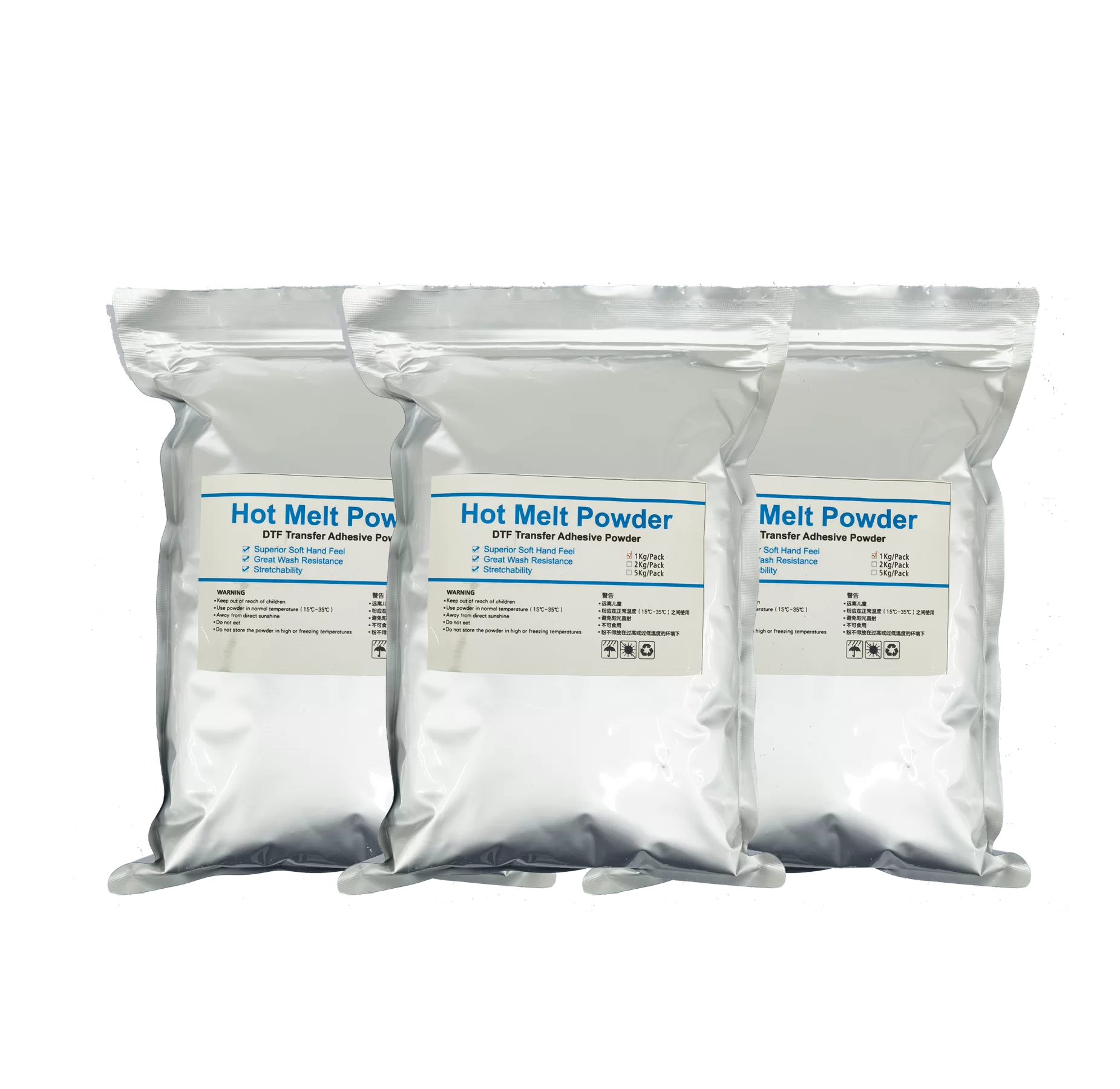
DTF hot melt adhesive powder is the bonding layer that makes a DTF transfer stick to fabric. While ink and film get most of the attention, the powder's particle size — measured in microns (µm) — directly determines how evenly it covers the printed image, how the adhesive layer behaves during heat pressing, and how the final print feels on different fabrics.
This guide explains what the 80-170 micron range means in practice, how ChromaBind's three powder grades compare, and how to approach grade selection by fabric type and application. Because every production environment is different, the most reliable method remains testing a sample on your actual fabric before committing to bulk.
View DTF hot melt powder product specs
What does DTF powder particle size mean?
Particle size refers to the diameter of the individual TPU (thermoplastic polyurethane) granules that make up the hot melt powder. It is measured in microns (µm):
- 1 micron = 0.001 mm
- 80-170 micron = 0.08 mm to 0.17 mm
The range describes the sieve cut — the powder passes through a mesh that retains particles above 170u and lets particles below 80u fall through. A narrow, consistent cut means the powder melts and flows more predictably during heat pressing.
How particle size affects the DTF process
| Factor | Finer particles (closer to 80u) | Coarser particles (closer to 170u) |
|---|---|---|
| Powder coverage | More even, less visible grain | Heavier coating, more texture |
| Hand feel | Smoother, softer touch | Slightly textured, more grip |
| Melt flow | Faster melt, thinner bond line | Slower melt, thicker bond line |
| Application | Light fabrics, performance wear | Heavy fabrics, workwear, bags |
Understanding this trade-off is the first step in choosing the right grade for your production.
ChromaBind DTF powder grades at a glance
ChromaBind's DTF hot melt powder is available in three grades, all falling within the 80-170 micron range:
| Grade | Particle size | Recommended use | Pack format examples |
|---|---|---|---|
| ep005 80-170u | 80-170 micron | General DTF transfer production | 20kg carton, 1kg/5kg packs, 20kg drum, 25kg bag |
| ep001 80-170u | 80-170 micron | DTF transfer production | 20kg carton |
| 1-NO | Not specified | DTF transfer production | 20kg carton |
All three grades are TPU hot melt adhesive powders designed for DTF transfer. The 20kg carton variant for each grade has recorded carton dimensions, CBM, and gross weight — see our DTF hot melt powder pack formats guide for full packing specs.
Important: Particle size and grade recommendations are starting points. The optimal grade for your production depends on your specific fabric, printer, heat press parameters, and end-use requirements. Free sample support is available so you can test before committing to a bulk order.
How DTF powder particle size interacts with fabric
Cotton and cotton blends
Cotton fibres are absorbent and textured at a microscopic level. A medium particle size in the 80-170 micron range typically provides good mechanical adhesion — the melted powder flows into the fibre structure without excessive strike-through.
- For 100% cotton T-shirts and light apparel, a standard 80-170u grade works well. The powder melts into the fabric surface without bleeding through to the back.
- For heavy cotton items (workwear, aprons, tote bags), a grade on the coarser end of the range may provide better adhesion on the thicker weave.
Polyester and synthetic fabrics
Polyester fibres are smoother and more heat-sensitive than cotton. The melt temperature of the TPU powder needs to match the fabric's heat tolerance:
- Standard polyester (lightweight sportswear, running singlets) — a standard TPU 80-170u grade is commonly used in production shops.
- Performance fabrics with moisture-wicking or water-repellent coatings — the coating can interfere with adhesion. Sample testing is essential here.
- Nylon and polyamide blends — these require lower pressing temperatures to avoid fabric damage, which affects powder melt behaviour.
Polyester-cotton blends (50/50, 65/35)
Blended fabrics are among the most common substrates in commercial DTF production. The 80-170u range is the industry standard for these blends. The cotton component provides fibre texture for mechanical grip; the polyester component limits absorbency. Blends typically produce clean, durable transfers with standard-grade powder.
Specialty fabrics: denim, canvas, leather
- Denim — Heavy, textured weave. A standard 80-170u grade is usable, but some production shops prefer a grade with more coarse particles for deeper weave penetration.
- Canvas and upholstery fabric — Thick, open weave. Correct powder coverage becomes more important than particle size variation; a consistent, uniform melt is the priority.
- Leather and PU (synthetic leather) — Heat-sensitive, non-porous surface. Bonding depends more on the powder's adhesive formulation than on particle size. Sample testing is strongly recommended.
How to choose: practical decision framework
When selecting a DTF powder grade, consider these four questions:
1. What fabric types make up most of your production?
If you print primarily on cotton and cotton-polyester blends (the most common mix for custom apparel), a standard 80-170u grade is a safe starting point. If you print on a wide range of materials — from performance polyester to heavy denim — you may want to stock two grades and switch based on the job.
2. What hand feel does your customer expect?
Smooth, soft-feel transfers (for sportswear, fashion apparel) benefit from a powder that melts into a thin, even bond line. Heavier applications (bags, patches, workwear) can tolerate a thicker adhesive layer.
3. What is your heat press setup?
- Temperature range: TPU hot melt powders typically activate between 140-170°C (280-340°F). Your press temperature should be matched to both the powder grade and the fabric type.
- Pressure: Consistent, even pressure across the platen ensures the melted powder forms a uniform bond layer. Uneven pressure can cause patchy adhesion regardless of particle size.
- Time: Longer press times allow coarser particles to fully melt and flow. Shorter cycles favour finer particles.
4. Are you testing before scaling?
The most common mistake production shops make is committing to a bulk order of DTF powder without first testing a sample on their actual fabric and press. Particle size grade recommendations are general guidelines — your specific printer model, ink combination, film type, heat press calibration, and fabric all interact differently.
ChromaBind supports free sample orders for qualified buyers. A typical sample request includes:
- Target grade (ep005, ep001, or 1-NO)
- Fabric type(s) you intend to print on
- Current printer and film setup
- Estimated monthly volume (so we can match the sample pack format)
Sample-first approach: why it matters for powder selection
No two DTF production lines are identical. The same powder grade can produce different results on:
- Different printers (EPSON vs Ricoh print heads lay down different ink volumes)
- Different films (single-side vs double-side, domestic vs premium)
- Different heat press models (temperature calibration varies ±5-10°C between machines)
- Different fabric batches (dye lots and finishes affect surface adhesion)
A sample-first, batch-consistent approach means:
- You request a sample of the specific grade you are evaluating
- You run your standard production workflow on your actual fabric
- You test wash adhesion, stretch performance, and hand feel
- If the result meets your standard, you order with confidence that subsequent batches are produced to the same specification
For more on how ChromaBind structures consistent supply, see our DTF consumables quoting guide for what to look for in a supplier's spec sheets.
Summary: matching grade to fabric
| Fabric type | Suggested approach | Key consideration |
|---|---|---|
| 100% cotton (light) | Standard 80-170u grade | Test for strike-through on thin knits |
| 100% cotton (heavy) | Standard 80-170u grade | Heavier weave may need more powder per print |
| Polyester (standard) | Standard 80-170u grade | Mind pressing temperature — polyester can scorch |
| Polyester (performance) | Sample test required | Moisture-wicking coatings affect adhesion |
| Cotton-poly blends | Standard 80-170u grade | Most forgiving substrate combination |
| Nylon / polyamide | Sample test required | Low heat tolerance, check compatibility |
| Denim / canvas | Standard 80-170u grade | Thick weave; ensure even powder coverage |
| Leather / PU | Sample test strongly recommended | Non-porous surface, bond is formulation-dependent |
Note: These are general guidelines based on industry practice, not verified laboratory classifications. ChromaBind does not claim REACH, RoHS, or other certification status for its powder grades without verified documents. Documentation including SDS/MSDS for DTF powder is available on request, to be verified.
How to request a DTF powder sample
If you are evaluating DTF powder grades for your production line:
- Identify your primary fabric types and monthly consumption
- Note your current printer model, film type, and heat press settings
- Submit an RFQ specifying the grade(s) you want to test (ep005, ep001, or 1-NO) and your pack format preference (1kg sample, 20kg carton, or 25kg bag)
- We will confirm sample availability and freight terms by destination
All ChromaBind powder SKUs ship with recorded carton dimensions, CBM, gross weight, and HS reference 3909500000. Prices and commercial MOQ are confirmed per order; lead time depends on grade, pack format, quantity, and production schedule.