
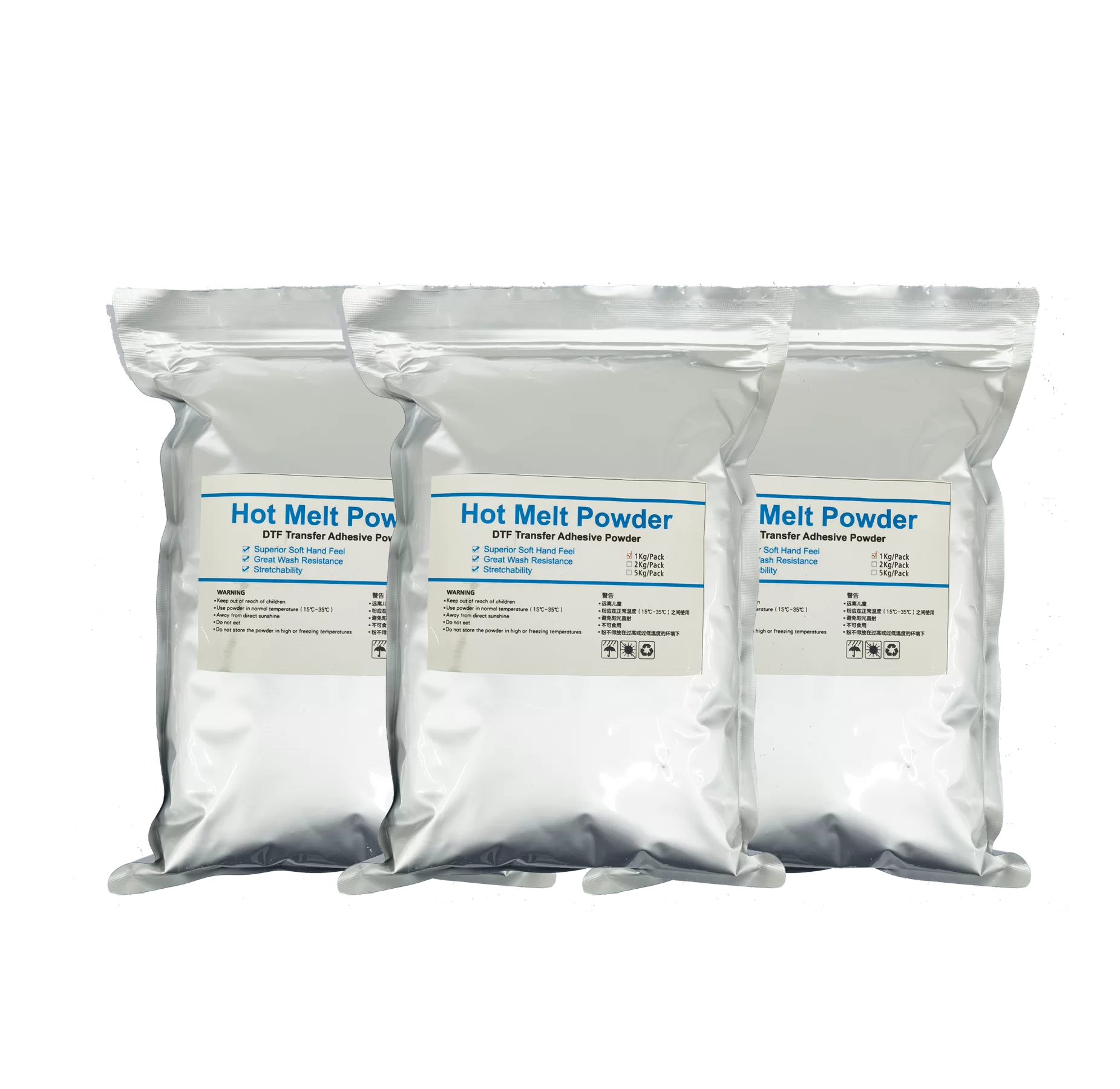
When you import DTF hot melt adhesive powder, the pack format you choose changes three things at once: your per-kilogram landed cost, how you store and handle the material at your warehouse, and whether you need to repack before selling to your own customers.
ChromaBind stocks six powder pack formats — from 1 kg retail-ready sub-packs to 25 kg bulk bags. Every SKU carries recorded carton dimensions, gross weight, and cubic volume (CBM), so you can estimate freight and container loading before you commit to an order.
This guide walks through each format, explains which buyer type it suits, and shows the container math from a single carton to a 20GP full load.
View DTF hot melt powder product specs →
The six pack formats at a glance
| Pack format | Net weight | Gross weight | Carton dimensions (m) | CBM per unit | Packs per carton |
|---|---|---|---|---|---|
| 1 kg sub-pack in 20 kg carton | 20 kg | 21 kg | 0.27 × 0.53 × 0.25 | 0.0358 | 20 × 1 kg |
| 5 kg sub-pack in 20 kg carton | 20 kg | 21 kg | 0.27 × 0.53 × 0.25 | 0.0358 | 4 × 5 kg |
| 20 kg carton (ep005 / ep001 / 1-NO) | 20 kg | 22 kg | varies by grade* | 0.0383–0.0501 | 1 carton |
| 20 kg drum | 20 kg | 22.5 kg | 0.34 × 0.34 × 0.47 | 0.0543 | 1 drum |
| 25 kg drum | 20 kg** | 23.5 kg | 0.34 × 0.34 × 0.47 | 0.0543 | 1 drum |
| 25 kg bag | 25 kg | 26.2 kg | 0.76 × 0.42 × 0.12 | 0.0338 | 1 bag |
*20 kg carton dimensions by grade: ep005 80-170u — 0.52 × 0.35 × 0.25 m (0.0501 m³); ep001 80-170u — 0.52 × 0.32 × 0.23 m (0.0383 m³); 1-NO — 0.645 × 0.21 × 0.21 m (0.0383 m³).
**Factory source lists net weight 20 kg for the 25 kg drum row. Verify net weight before quoting — contact our team for the confirmed figure.
All formats use TPU hot melt adhesive, grade ep005 or ep001 with particle size 80–170 micron (the standard range for DTF transfer production). HS reference: 3909500000.
Which format fits your business?
1 kg sub-packs (20 per carton)
Best for: e-commerce sellers on Amazon, Shopee, Lazada, or Mercado Libre who sell direct to small print shops and hobbyists. Each 1 kg pack is retail-ready — your customer opens a sealed bag and uses it.
Trade-off: Higher packaging overhead per kg. The carton itself (0.27 × 0.53 × 0.25 m) is compact, which helps with courier-friendly dimensions, but you pay for 20 individual bags and the carton weight per 20 kg net.
5 kg sub-packs (4 per carton)
Best for: Distributors serving small-to-mid-size DTF studios. The 5 kg format reduces repackaging labour compared to 1 kg but still keeps quantities small enough for shops that order monthly rather than by the pallet.
Trade-off: Same carton dimensions as the 1 kg format (0.27 × 0.53 × 0.25 m). If your customers regularly buy 20 kg or more, the 20 kg carton is more efficient.
20 kg carton
Best for: Production print shops that run daily DTF volume and reorder by the carton. Also works for distributors who break bulk into their own branded packaging.
Trade-off: Carton dimensions vary by powder grade — ep005 cartons use more volume (0.0501 m³) than ep001 or 1-NO (0.0383 m³). If you are container-loading a single grade, this CBM difference matters across hundreds of cartons.
20 kg and 25 kg drums
Best for: Industrial users and importers who prefer sealed drum storage over cartons. Drums protect against moisture and stack securely in warehouse racks.
Trade-off: Drums have the highest CBM per net kilogram (0.0543 m³ for 20 kg = 0.00272 m³/kg) — nearly double the volume efficiency of a 25 kg bag. Use drums when storage conditions demand it, not for maximising container density.
25 kg bag
Best for: Bulk importers and large distributors who repack into their own branded bags or feed directly into production. The 25 kg bag is the most CBM-efficient format ChromaBind offers.
Trade-off: Bags require palletising or careful handling — they do not stack as neatly as cartons or drums. If your warehouse uses racking designed for cartons, factor in handling adjustments.
Container math: carton → pallet → 20GP
Here is how ChromaBind's 20 kg cartons scale through palletising to a full container, using recorded packing data:
| Stage | Unit count | Net weight | Gross weight | Volume |
|---|---|---|---|---|
| 1 carton (20 kg) | 1 | 20 kg | 21–22 kg | 0.0358 m³ |
| 1 pallet (36 cartons) | 36 | 720 kg | 735 kg | 1.9965 m³ (1.1 × 1.1 × 1.65 m) |
| 20GP container (639 cartons) | 639 | 12,780 kg | 13,419 kg | 22.5 m³ |
A standard 20GP container has roughly 28–33 m³ of internal volume depending on the exact container model. At 22.5 m³ of loaded cartons, there is space remaining for dunnage, pallets, and loading clearance — the 639-carton figure represents a realistic working load, not a theoretical maximum.
How to use these numbers for your freight quote
- Pick your format from the table above and note its CBM per carton.
- Multiply by the number of cartons you plan to order to get total CBM.
- Multiply carton count by gross weight to get total shipment weight.
- Send both figures to your freight forwarder along with your destination port.
Example: 100 cartons of 1 kg sub-packs (ep005) = 100 × 0.0358 = 3.58 m³ at 100 × 21 = 2,100 kg gross. Your forwarder quotes LCL or FCL based on whichever is higher — the weight or the volume (chargeable weight).
CBM efficiency comparison
| Format | CBM per carton | Net kg per carton | CBM per net kg | CBM per net tonne |
|---|---|---|---|---|
| 1 kg sub-pack carton | 0.0358 | 20 | 0.00179 | 1.79 m³ |
| 5 kg sub-pack carton | 0.0358 | 20 | 0.00179 | 1.79 m³ |
| 20 kg carton (ep001) | 0.0383 | 20 | 0.00191 | 1.91 m³ |
| 20 kg carton (ep005) | 0.0501 | 20 | 0.00250 | 2.50 m³ |
| 20 kg drum | 0.0543 | 20 | 0.00272 | 2.72 m³ |
| 25 kg bag | 0.0338 | 25 | 0.00135 | 1.35 m³ |
The 25 kg bag is the most volume-efficient format — it packs 25 kg net into 0.0338 m³, giving you the lowest freight cost per kilogram on volume-rated shipments. The 1 kg and 5 kg sub-pack cartons are the next most efficient among carton formats. Drums carry a significant CBM penalty.
If you are filling a container, the difference between the best and worst CBM per net tonne (1.35 vs 2.72 m³) means roughly double the container space for the same net weight. That difference goes straight onto your freight invoice.
What the carton label tells you (and what it doesn't)
Every ChromaBind powder SKU records:
- Carton dimensions (L × W × H in metres)
- Gross weight per carton (product + packaging)
- Net weight per carton (product only)
- CBM (calculated from carton dimensions)
- Carton quantity (how many internal units per outer carton, e.g. "20 × 1 kg packs")
These are packing references, not commercial terms:
- Carton quantity ≠ MOQ. "20 packs per carton" describes how the product is packed, not the minimum you must buy. MOQ is confirmed per order — request a quote with your target SKU, quantity, and destination port.
- CBM is a freight-planning figure, not a guaranteed shipping charge. Actual freight depends on your forwarder, route, fuel surcharges, and whether you ship LCL or FCL.
- HS code 3909500000 is a reference. Final classification should be confirmed by your customs broker for the destination country.
Documentation and samples
ChromaBind's DTF powder carries factory documentation including SDS/MSDS and transport test reports (marine and air). These are available for manual confirmation — contact our team and specify which documents you need.
Free sample support is available for qualified buyers. Testing a sample lets you verify particle size (80–170 µm), adhesion on your fabric, and compatibility with your printer and film before committing to a bulk order. International sample freight is confirmed by destination.
Ordering your first powder shipment
- Choose your grade: ep005 80–170u (standard), ep001 80–170u, or 1-NO.
- Choose your pack format using the tables above — let your customer type and freight budget guide the decision.
- Estimate your volume using the CBM-per-carton figures.
- Request a quote with your grade, pack format, quantity, and destination port.
Our team will confirm packing, lead time (which depends on product, quantity, and production schedule), and shipping details. If you are also importing UV DTF AB film or other DTF consumables, ask about mixed-container loading to combine SKUs in one shipment.
Not sure which grade or format fits your production? Contact us with your printer model, typical fabric, monthly powder consumption, and whether you need retail-ready or bulk packaging. We'll recommend the matching pack format.