
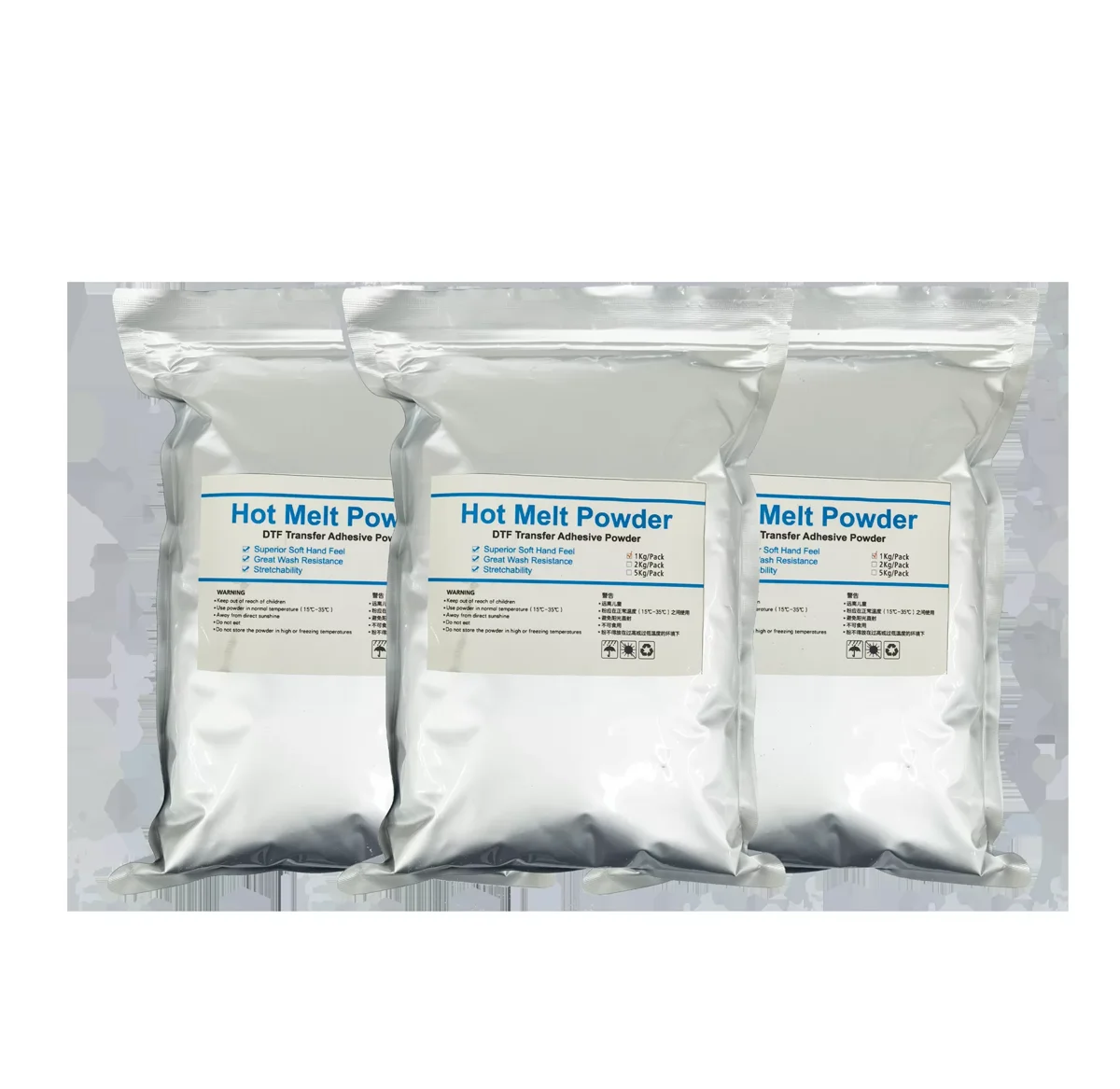
If you are comparing DTF hot melt powders, the first decision is chemistry, not particle size. For textile DTF work — T-shirts, hoodies, bags and sportswear — the workhorse is TPU (thermoplastic polyurethane) powder. Polyamide (PA) powder is a different adhesive chemistry that appears for harder or more specialised bonding jobs. ChromaBind's hot melt powder catalog is TPU-based, so this guide explains how the two behave and what to confirm before you buy in bulk.
TPU vs PA hot melt powder at a glance
| Property | TPU powder (typical) | PA / polyamide powder (typical) |
|---|---|---|
| Main use | Textile DTF transfers | Niche bonding and harder substrates |
| Hand feel | Soft and elastic | Firmer, less stretchy |
| Stretch recovery | Good on stretch fabrics | Lower |
| Wash behaviour on textiles | Strong when cured correctly | Depends heavily on substrate |
| Curing window | Wider and more forgiving | Can be narrower or higher-temperature |
These are general industry tendencies, not promises for a specific SKU. Confirm the exact melt point, curing window and wash behaviour against the supplier's TDS and your own sample run.
What "TPU" and "PA" actually mean
TPU is a polyurethane-based hot melt. It melts, flows into the ink layer and fabric, then re-solidifies into a bond that stays flexible. That flexibility is why TPU suits garment printing: the transfer can stretch and recover with the fabric instead of cracking.
PA (polyamide, sometimes called nylon-based powder) is a different polymer family. It can build a strong bond, but the cured film tends to be firmer and less elastic, which matters on soft or stretchy textiles. In practice, PA is not the default for DTF apparel; it is a specialised option for specific adhesion or temperature requirements.
Why TPU is the default for textile DTF
Softer hand and stretch recovery
Buyers repeatedly choose TPU because the finished transfer feels closer to the fabric. For a distributor selling into custom-apparel shops, that soft hand is a direct selling point — end customers notice a stiff or crack-prone print.
Wash and wear behaviour
With a correct cure, TPU transfers hold up through washing on cotton and cotton-blend garments. The bond quality still depends on the ink, film, powder coating weight and cure settings working together, which is why suppliers run a sample before bulk.
When polyamide powder enters the conversation
PA powder is worth asking about only when your application sits outside standard apparel: harder surfaces, special adhesion requirements, or a customer specification that names a polyamide grade. If a supplier offers a "PA" or "nylon" powder, ask exactly which substrate it is meant for and request its TDS before assuming it is interchangeable with your current TPU grade.
Grade codes are not the chemistry
A powder can be labelled with codes like ep005, ep001 or 1-NO. ChromaBind's live catalog lists its TPU powder under those grade codes with a stated particle size of 80–170 microns. The grade code is the supplier's internal label — it is not a chemistry claim. When you compare suppliers, ask for three things on the same sheet:
- the polymer chemistry (TPU vs PA),
- the particle size range in microns,
- the recommended melt point or curing window.
If two suppliers both say "80–170u" but only one names the chemistry, the first one has given you more of what you need to make a decision. See how particle size maps to fabric for the full breakdown.
What to confirm before you order powder
- Chemistry — TPU or PA, stated on the TDS.
- Particle size range — in microns (ChromaBind's TPU powder is listed at 80–170u).
- Melt point / curing window — from the TDS, and matched to your oven or tunnel.
- Pack format and packing reference — carton quantity, gross weight and CBM (see the table below).
- HS reference — the current SKU record lists HS reference 3909500000 as a quote reference; final classification remains the importer's or broker's responsibility.
- SDS/MSDS and transport appraisal — documentation status is verified for the selected product and shipment, and available document identifiers and scope are shared with the quotation.
- Batch / lot traceability — so a repeat order can be matched to the last approved batch.
- Sample route — fee, quantity, freight and timing are confirmed case by case.
Example packing references for TPU powder
These are packing references read from the current ChromaBind SKU record — not MOQ.
| Pack format | Carton reference | Gross weight | CBM |
|---|---|---|---|
| 1kg pack ×20 (20KG carton) | 0.27 × 0.53 × 0.25 m | 21 kg | 0.0358 |
| 20kg carton | 0.52 × 0.35 × 0.25 m | 22 kg | 0.0501 |
| 20kg drum | 0.34 × 0.34 × 0.47 m | 22.5 kg | 0.0543 |
| 25kg bag | 0.76 × 0.42 × 0.12 m | 26.2 kg | 0.0338 |
Carton dimensions vary by grade and SKU; the exact reference is confirmed per SKU in the quotation. Carton quantity and packing are shipping references only. The commercial MOQ, price, lead time and sample terms are confirmed for your selected SKU, quantity, packing and destination in the quotation.
Run a sample before the bulk order
Chemistry and particle size only get you so far on paper. The reliable way to choose is a controlled sample run: print the same design with the candidate powder, cure it, then check peel, hand feel and wash on the actual fabric. We cover the full method in our bulk-order testing checklist.
If you are comparing TPU powder suppliers for a repeat consumables order, request a quote with your target pack format and destination, and we will confirm the packing reference, documentation scope and sample route for your SKU.
Sources
- DTF Database, "DTF Adhesive Powder Guide: TPU, PA, Mesh & Curing" — https://dtfdatabase.com/blog/dtf-powder-guide/ (general industry reference for TPU vs polyamide powder behaviour).